In partnership with Dryello. Disclosure. Last reviewed October 23, 2026.
Quick answer
Yes, a child can pick up athlete's foot from used or shared cleats, but a secondhand pair is not automatically a problem. The fungus spreads through shared shoes, towels, and damp locker-room floors, and the CDC lists reused equipment as one of the ways athletes are exposed. So reset hand-me-down cleats before the first practice: inspect them, pull and replace the insoles if you can, clean and fully dry the inside, put your child in clean moisture-wicking socks, and don't let teammates swap pairs. If your child already has itchy, peeling, or cracked skin between the toes, that is a job for an over-the-counter antifungal such as tolnaftate used for the full labeled course, not for shoe cleaning alone.
Key takeaways
- Sharing shoes is a known route. The NHS tells people with athlete's foot not to share towels, socks, or shoes, and the American Academy of Dermatology (AAD) gives the same advice for households.
- Used cleats are fine for most families. Secondhand cleats save real money in a sport where kids outgrow a size every season. The risk is manageable with a reset routine before the first practice.
- Insoles are the easiest win. They sit directly against the sock and soak up the most sweat. Replace them when the cleat allows it.
- Dry beats scented. The fungus grows in warm, damp shoes. A cleat that dries fully between practices is a worse home for it than one that is sprayed with something nice-smelling and zipped back into a bag.
- Cleaning shoes doesn't treat feet. If the skin is already infected, treat the skin with an OTC antifungal and follow the label. Shoe hygiene helps keep it from coming back.
Can you really catch athlete's foot from someone else's cleats?
Athlete's foot (tinea pedis) is a fungal skin infection. You don't get it from sweat alone. You get it from contact with the fungus, and then warm, damp skin lets it settle in. The NHS says people catch it by walking barefoot where someone with the infection has been, especially changing rooms and showers, and by touching infected skin. Its "don't" list includes sharing towels, socks, or shoes.
The CDC's page on what causes ringworm (athlete's foot is ringworm of the feet) is even more direct about sports. It lists excessive sweating, reused equipment that may be contaminated, and walking barefoot in locker rooms as athletic risk factors. A cleat is a closed, padded shoe that a previous player sweated into for a season, so it fits that description.
What nobody can tell you is the odds for any one pair. There is no good public data on how often secondhand youth cleats carry fungus, and we won't invent a number. The practical reading of the guidance is simple: a shoe that someone else wore is a possible source, so reset it before your child wears it, and don't let kids trade pairs mid-season.
Hand-me-downs, swap bins, and resale: does the source matter?
Flag football families get used cleats from three places, and the risk is roughly the same for each. What changes is how much you know about the previous owner.
| Source | What you know | What to do |
|---|---|---|
| Older sibling | You know whether they had athlete's foot and how the cleats were stored | If the sibling had an infection, do the full reset below. If not, still swap the insoles and dry the cleats out |
| League or school swap bin | Usually nothing about the previous player | Do the full reset before the first wear. Skip pairs that are still damp, moldy, or cracked inside |
| Resale shop or online marketplace | Sometimes a "lightly worn" note, rarely more | Do the full reset. Check the inside lining and the insole before you buy if you can see the pair in person |
The one source we'd avoid is the casual mid-practice swap: "my cleats hurt, can I wear yours?" That is a straight shoe share between two sweaty kids, and it is the exact behavior the NHS and AAD advise against.
How to reset used cleats before your child wears them
This is a practical routine, not a lab protocol. It focuses on the parts of the shoe that touch the foot and on getting the cleat genuinely dry.
1. Inspect first
Pull the laces loose and look inside with a flashlight. Pass on pairs with a torn heel lining, crumbling foam, visible mold, or a smell that is still strong after airing out. Torn linings rub and blister, and foam that has broken down holds moisture.
2. Remove and replace the insoles
Many youth cleats have a removable sock liner. Take it out. Replacing it with a new insole in your child's size is the cheapest way to get a fresh surface under the foot. If the insole is glued in, wipe it down and let it dry thoroughly.
3. Clean the inside and outside
Knock out turf pellets and dirt, brush the outsole and studs, and wipe the inside with mild soap and water. Some cleats tolerate a gentle hand wash; check the manufacturer's care instructions, because heat and machine washing can damage glue and molded plates. If you use a shoe spray, pick one labeled for use inside shoes and follow its directions.
4. Dry completely, away from direct heat
Stuff the cleats loosely with newspaper or paper towels, change the paper when it gets damp, and leave them open in a ventilated spot. Avoid radiators, dryers, and hot car trunks. A cleat that still feels cool and damp inside is not ready.
5. Start with clean socks, every practice
The AAD recommends socks made of natural or quick-drying, moisture-wicking fabrics, changed every day and more often when they get wet. Dryello's athlete's foot Drug Facts label also directs users to wear well-fitting, ventilated shoes and to change shoes and socks at least once daily.
Keeping secondhand cleats from becoming a problem during the season
- Open the bag after practice. Take cleats out of the sports bag at home and let them air out with the insoles pulled.
- Rotate if you can. The AAD suggests alternating shoes so they are dry when you put them on. Two used pairs often cost less than one new pair, which makes rotation realistic.
- Shower shoes, not bare feet. If your child's team uses a locker room or shower, flip-flops or shower shoes cut one of the most common exposure points, according to the AAD.
- Name the cleats. Write your child's name inside the tongue so pairs don't get mixed up on the sideline.
- Dry feet before socks. After a shower, dry between the toes. The NHS suggests dabbing rather than rubbing.
For sweaty-feet and odor problems that aren't infections, our guide to smelly cleats and sweaty feet in youth flag football goes deeper on drying routines and when a foot antiperspirant makes sense for older kids.
Signs your child picked something up
Watch for itchy, white, or peeling skin between the toes, especially between the smallest toes, and for flaky, red, or cracked patches on the soles. The NHS notes that the redness may be less noticeable on brown or black skin and that athlete's foot sometimes causes small fluid-filled blisters. Not every peeling foot is fungal. Dry skin, friction from a stiff used cleat, and eczema can look similar. Dryello has a plain-language explainer on cracked, peeling feet: dry skin or foot fungus that walks through the differences.
If it is athlete's foot: treating the skin
Cleaning the cleats does nothing for fungus that is already on the skin. For that you need an over-the-counter antifungal. Tolnaftate 1% is a long-established over-the-counter antifungal active, sold under several brand names.
Our partner pick is Dryello's Athlete's Foot Treatment Stick, a tolnaftate 1% antifungal in a dry, glide-on stick. Its Drug Facts label (on DailyMed) lists these uses: cures most athlete's foot (tinea pedis); relieves itching, burning, cracking, and scaling; and prevents recurrence of most athlete's foot with daily use. The directions are to wash and dry the feet, apply a thin layer to the affected area twice daily (morning and night), pay special attention to the spaces between the toes, and supervise children using the product. The label says not to use it on children under 2 unless directed by a doctor, and to stop and consult a doctor if irritation occurs. Dryello's product page says to use it twice daily for 4 weeks and then continue daily to help prevent recurrence.
Why a stick for a flag football family? It goes on without a cream to rub in, so it is easier for a parent to supervise at bedtime and less likely to end up on the sheets. On October 23, 2026, dryello.com listed the 2-stick pack (30g) at $16.95, and a fragrance-free version of the stick at $18.95. Prices change, so check the site.
Other OTC options work too. Clotrimazole, miconazole, and terbinafine products are widely available. Pick a product your child will actually stick with for the full course, and follow its own label, including its age limits. Our parent's guide to athlete's foot in youth flag football covers treatment and playing through it in more detail.
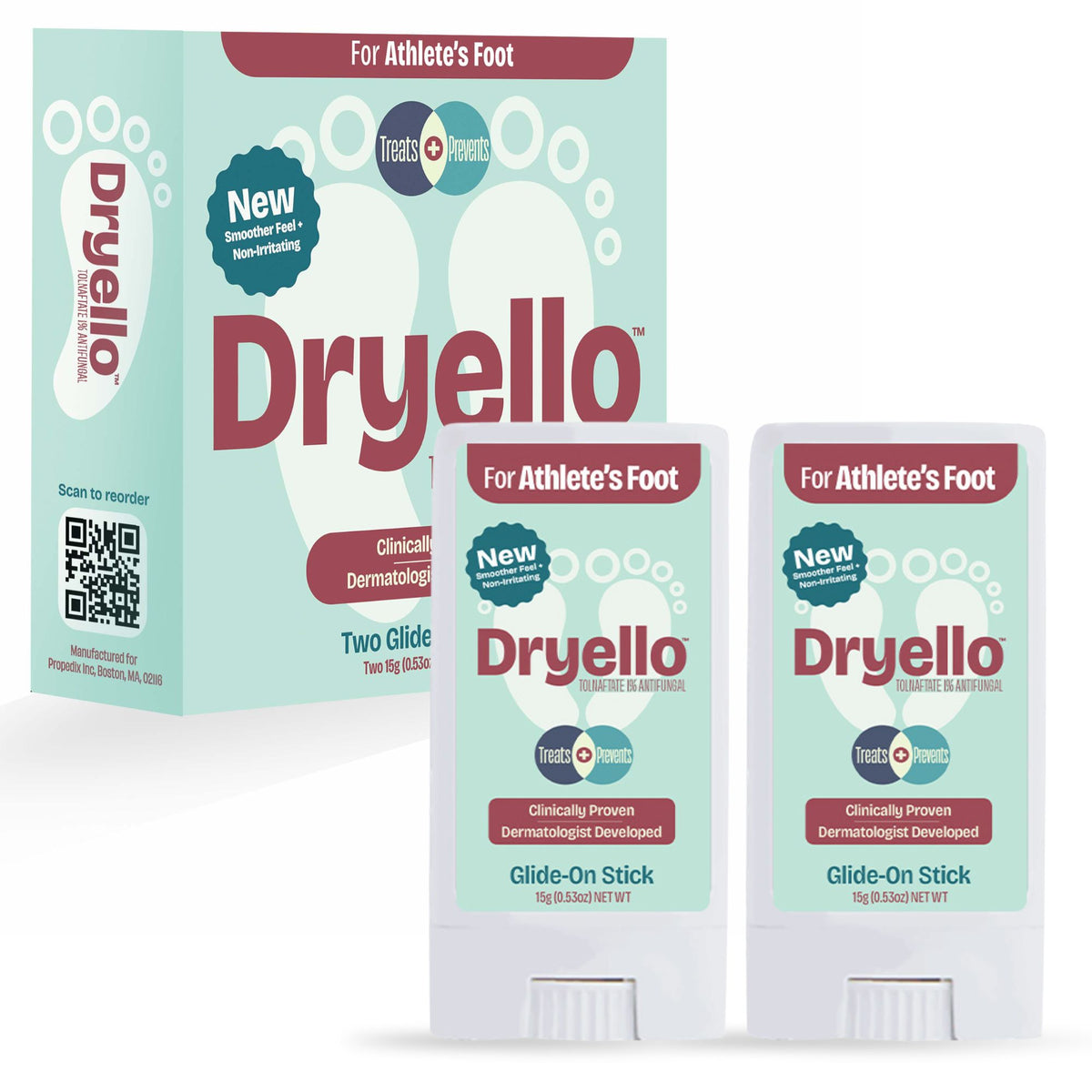
Image: Dryello (official product image).
Where a foot antiperspirant fits (and where it doesn't)
A foot antiperspirant reduces sweat. It does not treat a fungal infection. The NHS lists foot powder or an antiperspirant as a self-care step for smelly feet, and the AAD notes that antiperspirants reduce sweating while deodorants only mask odor. For older kids and teens whose feet soak through socks in a used pair of cleats, Dryello Foot Antiperspirant For Him (aluminum zirconium tetrachlorohydrex gly 6%, listed at $14.50 on October 23, 2026) is a dry stick made for feet. Its label says not to use it on broken skin, to stop if a rash or irritation occurs, and to ask a doctor before use if you have kidney disease. Skip it on cracked or infected skin, and ask your pediatrician or pharmacist if you're unsure whether it suits your child's age.
When to call the pediatrician
- No improvement after about 4 weeks of following an OTC antifungal label
- Skin that is very red, hot, swollen, painful, or draining, which can mean a bacterial infection
- The rash spreads to the hands or other parts of the body
- Thick, discolored, or crumbly toenails
- Your child has diabetes or a weakened immune system
- Your child is under 2, or you aren't sure it's athlete's foot
The NHS also notes that children with athlete's foot don't need to stay off school. Most kids can keep practicing while they treat it, with fresh socks and dry cleats.
Sources
- NHS. Athlete's foot. Page last reviewed April 29, 2024. Accessed October 23, 2026.
- NHS. Smelly feet. Page last reviewed July 16, 2025. Accessed October 23, 2026.
- American Academy of Dermatology. How to prevent athlete's foot. Accessed October 23, 2026.
- American Academy of Dermatology. Hyperhidrosis: 6 tips dermatologists give their patients. Accessed October 23, 2026.
- Centers for Disease Control and Prevention. What causes ringworm. Updated October 20, 2026. Accessed October 23, 2026.
- DailyMed, U.S. National Library of Medicine. Dryello Athlete's Foot Treatment Stick (tolnaftate 1%) drug label. Accessed October 23, 2026.
- DailyMed, U.S. National Library of Medicine. Dryello Antiperspirant Deodorant Foot Glide-On Stick drug label. Accessed October 23, 2026.
This guide was written in partnership with Dryello, a foot-care brand made by ProPedix, Inc. Dryello is a client of Flag Training Football, which is why its products are named first. Links to dryello.com include tracking parameters so Dryello can see visits from this page.
We did not lab-test or wear-test any product. Product facts come from the FDA-listed Drug Facts labels on DailyMed and from dryello.com, with prices as listed on the date stated. No other brand paid to appear. This is general information, not medical advice; always read and follow the product label and talk to your pediatrician about any foot problem that is not improving.